One of the Greatest Difficulties of Online Mutual Aid: It Differs in Kind from Commercial Insurance, Yet Still Looks Too Much Like It
The greatest predicament of online mutual aid is often neither technology nor funding, but a mismatch in perception.
On the surface, it looks far too much like commercial insurance. It also sets disease definitions, exclusions, and application conditions, and much of its wording borrows directly from insurance terminology familiar to the public for the sake of clarity. To ordinary people, all they see is that after joining, they can get a sum of money if they suffer a critical illness. And precisely because this surface-level ruleset is so similar, the vast majority instinctively measure everything about a mutual aid platform by the yardstick of insurance.
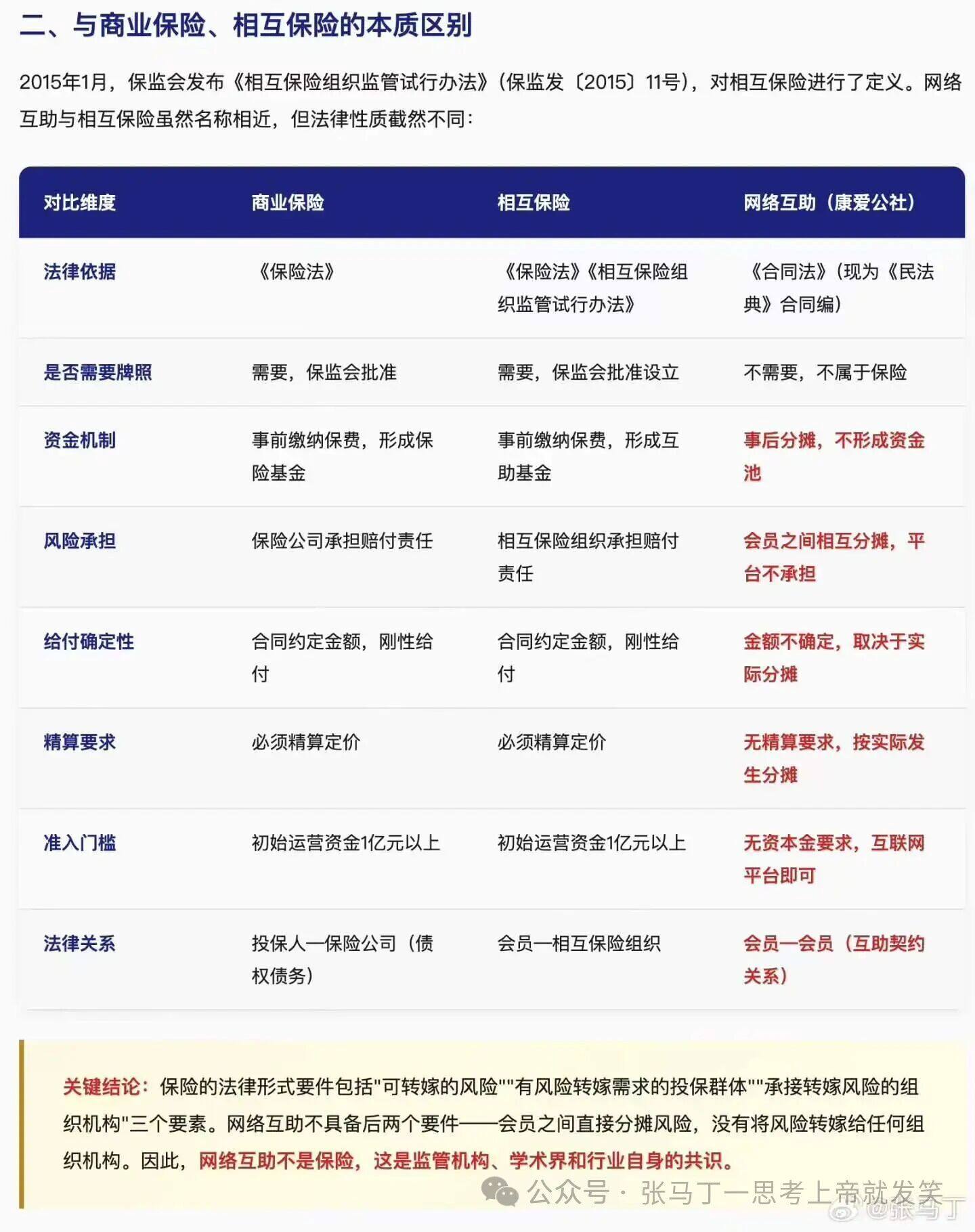
But strip away the surface terms and the two operate on entirely different underlying logic. Commercial insurance is risk transfer: the user pays premiums, the risk passes to the insurer, and whatever the contract states must be paid out rigidly; the institution bears the payout liability as the principal, with a license, reserves, and an entire actuarial system as its foundation. Online mutual aid, by contrast, is risk-sharing among members: the platform is merely the organizer, it does not take on risk or make rigid payouts, and the assistance funds come from contributions shared by all members—every sum of mutual aid money is donated by ordinary people, one contribution at a time.
The real difficulty is this: the platform repeatedly declares to the outside world that "we are not insurance," yet the wording of the terms looks similar, the user experience looks similar, and outsiders find it very hard to truly grasp the difference in the mechanism behind them. The moment an application is rejected, contribution amounts rise, or the amount actually received falls short of expectations, people's first reaction is to challenge it by the standard of insurance: why can't the protection you promised be delivered? Why can't you pay as steadily as insurance? Many misunderstandings, disputes, and public controversies arise from this. Repeated written declarations alone can hardly break such a preconceived impression.
KangAi Commune's decision to revive the visitation team and the adjudication panel is essentially an attempt to break out of the predicament of relying on written notice alone and, through a set of community mechanisms that belong to mutual aid itself, to draw the distinction at the level of reality.
Commercial insurance settles claims through an internal closed loop within the insurer, with the institution making the final determination. By contrast, the visitation team has ordinary members make on-site visits to verify the real circumstances of the recipient, and the adjudication panel has member representatives take part in reviewing and judging disputed cases, returning part of the power of verification and judgment to the community itself. No institution decides unilaterally; members take part together and supervise one another to complete the verification of facts and the resolution of disputes.
This mechanism precisely embodies the core of mutual aid: risk is not backstopped by some single institution, but is watched over and jointly safeguarded by all members. It is not an institution promising payouts to users, but members holding each other up.
On paper, one can write clearly "this is not insurance," but for the outside world to truly see the difference, a visible operating process is needed. Visitation and adjudication make the community character of mutual aid concrete. They tell everyone: this is not an institution selling protection, but a group of ordinary people banding together to help one another, with verification, judgment, and cost-sharing all carried out through the shared participation of the community.
But this path remains difficult. The public has grown accustomed to the insurance paradigm, and changing that perception cannot be accomplished by restoring a system once or twice. On one hand, we must borrow mature, clear rule texts; on the other, we must keep explaining that the underlying logic is entirely different. On one hand, we are building a co-governance system with member participation; on the other, we must keep defusing the various gaps in expectation that arise when the public applies the standards of insurance—this is precisely the real predicament that online mutual aid must face over the long term.
Attached is a chart explaining the difference between online mutual aid and insurance:
Founder, KangAi Commune