Does a Larger Membership in Mutual Aid Mean Lower Cost-Sharing? Not at All!
Many friends keep agonizing over cost-sharing. By the usual understanding, mutual aid works by pooling everyone's strength to help one person—so doesn't a larger membership mean lower cost-sharing for us?
Actually, this is a misconception caused by our habitual thinking. Because the incidence rate is basically fixed, as the number of members grows, the number of people falling ill grows correspondingly; it does not lower cost-sharing.
Let me briefly explain why cost-sharing, which starts at a few cents in a platform's early days, will eventually rise gradually and then stabilize.
First, let's look at the basic composition of cost-sharing. After removing additional costs such as platform management fees (and here I have to mention that KangAi Commune currently charges the lowest management fee on the internet), we can express the cost-sharing amount with the following formula:
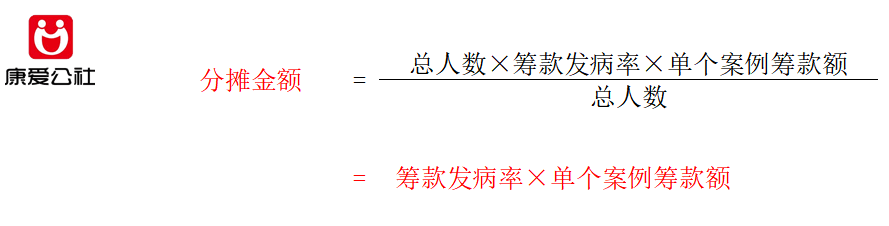
Incidence rates differ by age group, but KangAi sets the critical-illness mutual aid amount according to the age at which one joins, which keeps the cost-sharing amount basically stable: when age rises and incidence increases, the mutual aid amount also decreases. So the average amount raised per case can be regarded as a relatively fixed value, which means what mainly affects the cost-sharing amount is the fundraising incidence rate.
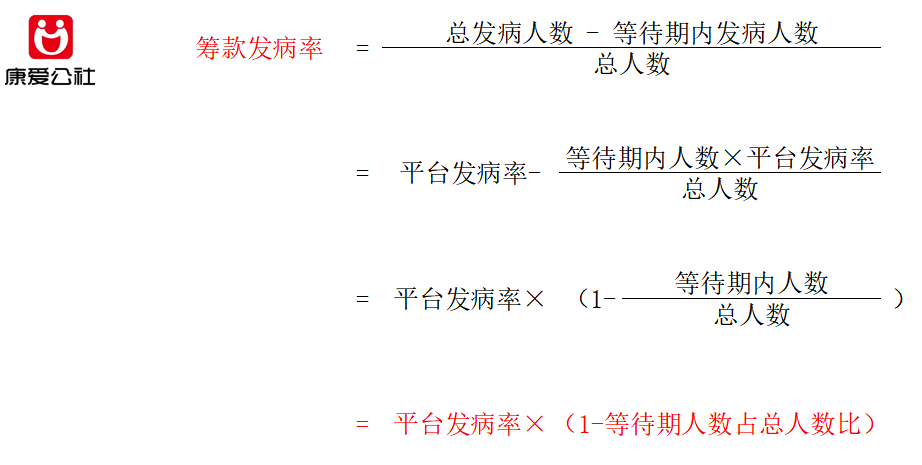
From the analysis above, we can see that the fundraising incidence rate is mainly affected by the number of people still within the waiting period—that is, the more people in the waiting period, the lower the fundraising incidence rate.
Members within the waiting period must bear cost-sharing but cannot enjoy mutual aid benefits, which creates a demographic dividend for those of us who joined early. In a newly established mutual aid society, everyone is in the waiting period, and cost-sharing in the early days will remain at zero yuan for some time. But once most people have passed the waiting period, this demographic dividend is bound to fade away. An extreme example: if everyone in China joined KangAi Commune, the waiting-period demographic dividend would no longer exist. So the common belief that more members means lower cost-sharing is wrong.
So does the number of members affect cost-sharing at all?
The answer is: it does, but not in the way everyone previously assumed!
Growth in the number of members increases the platform's stability and makes the platform's incidence rate approach the national comprehensive incidence rate. The smaller the number of people, the larger the deviation in the average. For example, if you measure the incidence rate among 100 people, a single case makes the incidence rate 1%, a huge deviation from the national data. So the more members there are, the more stable the platform's incidence rate and the closer it comes to the national average.
As a platform that has been operating for nine years, KangAi Commune has the strongest stability in the industry. Judging from cost-sharing data and the number of people falling ill in recent years, the platform's incidence rate is generally stable and remains much lower than the officially published national incidence rate.
Why is the cost-sharing on some platforms relatively low?
This brings us to the amount raised per case. Incidence rates all tend toward the national comprehensive rate, so the difference in cost-sharing between platforms, after removing factors such as management fees, is essentially the difference in the benefits people actually receive.
Option 1: One yuan per month, coverage of 90 critical illnesses, reimbursement of up to 150,000 yuan based on actual medical expenses.
Option 2: One yuan per month, no restriction by disease type, reimbursement of up to one million yuan for out-of-pocket hospitalization costs exceeding 10,000 yuan.
Option 3: Three yuan per month, coverage of 115 critical illnesses, a direct payout of up to 150,000 yuan (with no restriction on use).
Given these three options, how would you choose? For a few extra yuan a month, the difference in benefits is hundreds of thousands of yuan. I believe everyone would rather spend a few extra yuan to obtain higher protection.
KangAi Commune also offers a more comprehensive protection package:
KangAi Critical-Illness Mutual Aid Society + Anti-Cancer Mutual Aid Society + Million Medical Supplementary Mutual Aid Society + Comprehensive Accident Mutual Aid Society.
You can obtain the following mutual aid:
1. For hospitalization medical costs not restricted by disease type (except AIDS), the portion of out-of-pocket expenses above 10,000 yuan is reimbursable, up to a maximum of one million yuan.
2. For 114 critical illnesses, a lump sum is paid upon diagnosis, up to a maximum of 150,000 yuan.
3. For cancer, a lump sum is paid upon diagnosis, up to a maximum of 350,000 yuan.
4. For accidental disability or death, up to a maximum of 200,000 yuan.
The total annual cost-sharing for the above four mutual aid societies in 2019 was about 120 yuan per person (for adults), with minors bearing only one-third of the adult contribution. With a combination offering such high benefits, would you still think the cost-sharing is high?
Still think it's high? Then you can join just one mutual aid society—the Million Medical Supplementary Mutual Aid Society, whose total cost-sharing for a whole year in 2019 was less than 7 yuan per person!
For hospitalization due to illness (except AIDS) or accident, the portion of out-of-pocket costs above 10,000 yuan is reimbursable, up to a maximum of one million yuan.
Most importantly, there is no restriction on disease type and no restriction on imported drugs, and the benefit can be enjoyed for life!
Founder, KangAi Commune